



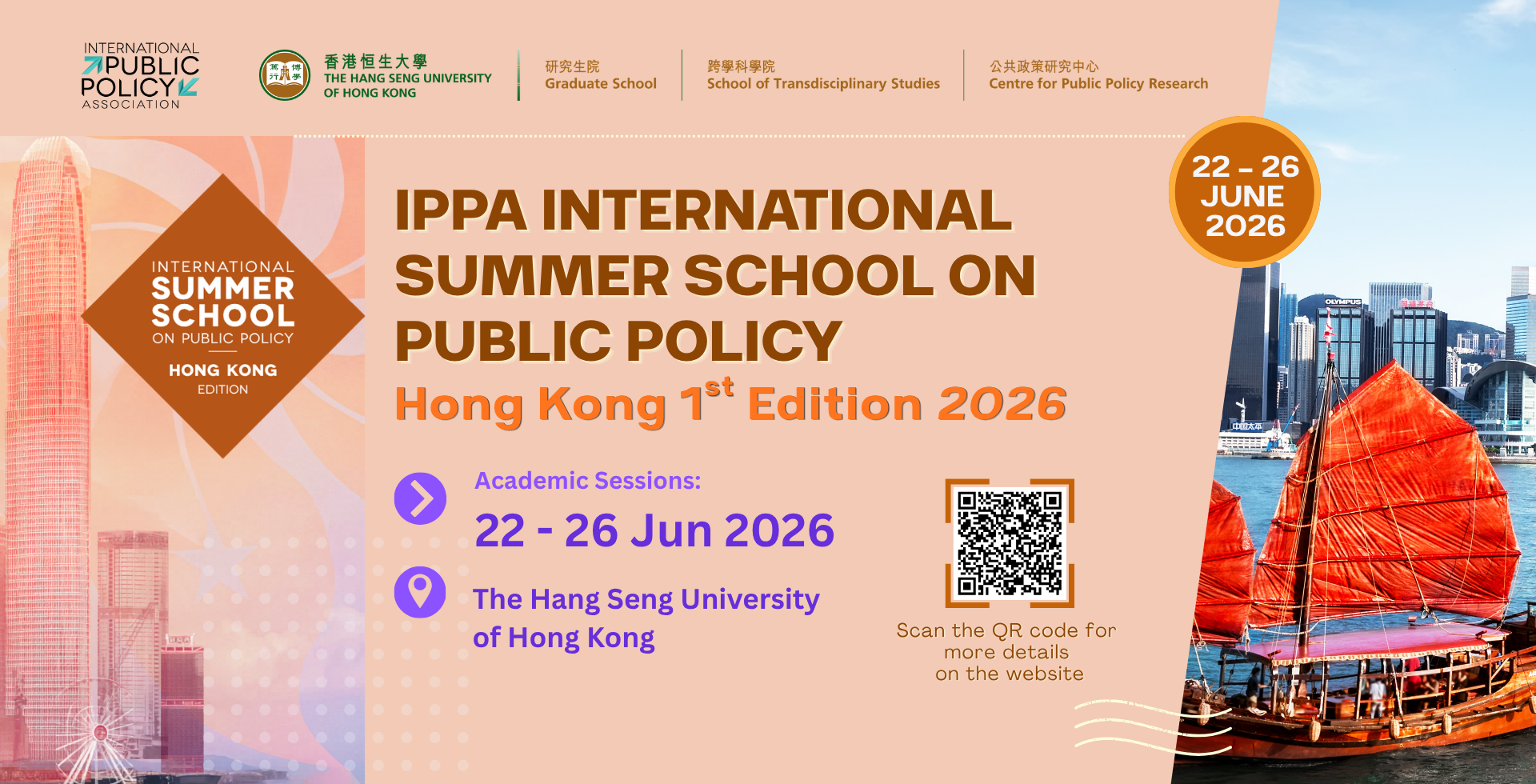
Graduate School of The Hang Seng University of Hong Kong (HSUHK) is proud to partner with the International Public Policy Association (IPPA) to host the first Hong Kong edition of the IPPA International Summer School on Public Policy. This intensive programme offers master students and early career researchers a unique opportunity to deepen their understanding of public policy theories, concepts, and methodologies through direct engagement with leading international scholars.
- Programme Duration: 21 June – 27 June 2026 (1 weeks)
- Academic Sessions: 22 – 26 June 2026 (5 full days)
- Location: The Hang Seng University of Hong Kong
- Target Audience & Eligibility:
- PhD students
- Early career researchers (post-doctoral and junior faculty) seeking to strengthen their theoretical and methodological foundations
Programme Content
- Programme Medium: English (Participants should have a sufficient command of English to actively engage in academic discussions, workshops, and group work.)
- Format: In-person participation including lectures, parallel courses, and workshops.
- Programme Course: (Choose 1 out of 3 and indicate your preference when registering for IPPA)
- Conceptualising and Measuring Policy Design. Instruments, Policy Capacity, and Robustness by Prof Giliberto Capano
- The Politics of Policy Advice: Understanding Policy Advisory Systems by Prof Laura Chaqués Bonafont
- Making Public Policies Work Effectively: Bringing Multiples Stakeholders' Perspectives Back in by Prof Joshua MOK Ka Ho & Dr Eva HUNG Po-wah
- Full Programme Schedule: [Click here]
Programme Fee
- Programme Fee: 250€(Payment should be made via the IPPA payment gateway.) The fee includes lunch and coffee breaks. Accommodation options are not included.
- Accommodation Fee (Optional): For 6 nights (check-in on June 21, check-out on June 27), the cost is 165€ for a twin-shared room or 330€ for a single room.
The Summer School is designed to advance participants' knowledge and research skills in public policy. Over fourteen days, students will attend lectures from distinguished international scholars, participate in specialised courses, and engage in interactive workshops. A key feature is the workshop sessions, where participants can present and discuss their own research projects, receiving valuable feedback from peers and acclaimed faculty in a collaborative, small-group setting.
- Expert Lectures: Gain insights from plenary lectures delivered by leading international scholars.
- Specialised Courses: Choose from parallel courses for in-depth exploration of specific public policy issues.
- Interactive Workshops: Present and discuss your research in small groups with direct feedback from peers and faculty.
- Academic Networking: Connect with fellow researchers and established academics during Welcome and Gala Dinners.
For more details, please visit the IPPA offical website.
Applications to attend the IPPA International Summer School on Public Policy – Hong Kong edition are open until April 20th, 2026. Please follow the steps below for registration:
- Log in or create an IPPA User Account
- Submit your application, CV, and an optional paper abstract and select your workshop sessions here: https://www.ippapublicpolicy.org/summerschool/summer-school-hong-kong-edition-2026/howToApply/69
- You will receive a confirmation email from the IPPA team within a few days, which will include detailed instructions regarding payment.
- Complete the course payment to secure your place.
Programme Instructors

Prof Azad Singh Bali
(University of Melbourne)
Azad Singh Bali is an Associate Professor of Public Policy at the University of Melbourne, and holds an honorary appointment at the Australian National University. Bali's expertise includes policy design, policy capacity, and comparative public policy. He has published extensively in leading international journals on these themes, and a recent book is Health Policy in Asia: A Design Approach. Bali frequently delivers executive education programs for national schools of public administration and practitioners on policy design and capacity including in Australia, Brazil, Greece, Italy, Portugal, Spain, Singapore, and Qatar. Prior to Melbourne, Bali held fellowships at the Australian New Zealand School of Government, Murdoch University and Hamad Bin Khalifa University.
Course: Conceptualising and Measuring Policy Design. Instruments, Policy Capacity, Robustness
Policy design is more than choosing tools—it is the architecture of collective action. This five-day course equips early-career researchers with the conceptual precision and measurement strategies needed to study how governments design policy and why those choices matter. The programme places conceptualisation first, then treats measurement as craft: translating ideas into indicators without losing meaning, and ensuring measures travel across cases and time.
We begin with fundamentals: what is policy design, and what constrains it? Participants learn to map the design space—the feasible options shaped by legal authority, resources, political conflict, and problem complexity. Understanding this space explains why some instruments become thinkable while others remain off the table, and how space expands or contracts after crises, reforms, or fiscal shocks.
From there, we move to policy instruments and their micro-design: the calibration, targeting, discretion, and enforcement rules that determine how interventions work. We link design choices to causal mechanisms—incentives, constraints, learning, compliance—and to their distributive effects. Participants discover how seemingly technical decisions carry profound political implications.
We then examine instrument mixes as portfolios embodying broader design logics. How do combinations interact—through complementarity, conflict, or redundancy? When do mixes stabilise policies, and when do they generate drift or incoherence? Sequencing and layering over time receive particular attention.
Policy capacity receives dedicated focus as both an enabler and a constraint of ambitious design. We unpack analytical, operational, and political dimensions, exploring what happens when designs exceed available capacity—and how smart design adapts to limitations rather than ignoring them. Understanding capacity helps explain why similar designs succeed in some contexts and fail in others.
The course culminates with robustness: how designs perform under uncertainty, shocks, and contestation. Participants develop tools to assess whether a policy will prove adaptive or brittle when its assumptions fail, connecting robustness to instruments and capacity in an integrated analytical framework.
Each session includes hands-on measurement work: coding instruments, mapping mixes, selecting capacity indicators, and stress-testing designs. Participants leave with a compact research portfolio that connects clear concepts to credible inferences.
Afternoon Programme
Mornings build knowledge; afternoons sharpen skills. Participants either present their own research projects on policy design, instruments, or capacity—receiving targeted feedback on how to refine their conceptualisation and measurement approaches—or work in groups on applied analytical exercises, systematically examining real policy cases through the conceptual and methodological lenses introduced in the morning lectures.

Prof Laura Chaqués Bonafont
(University of Barcelona and IBEI)
Laura Chaqués Bonafont is Professor of Political Science at the University of Barcelona and Director of the Institut Barcelona d'Estudis Internacionals (IBEI). In this role, she leads the institute's academic strategy, research development, and international partnerships, promoting interdisciplinary and globally oriented scholarship on public policy and international affairs. Her research examines how political agendas evolve across time, countries, and policy areas; how experts and interest groups gain influence in the policy process; and how democratic institutions respond to social, political, and economic challenges. She approaches these questions through large-scale comparative projects, innovative datasets, and interdisciplinary collaboration. Together with the Q-Dem team, Prof. Chaqués Bonafont has led the development of new tools and datasets that measure policy attention in Spain and internationally (www.q-dem.com).This work advances our understanding of democratic responsiveness and the media's role in shaping political processes. She also investigates how interest groups access the policy process, how they interact with policymakers, and how institutional, political, and media contexts shape their influence—highlighting systematic biases, media gatekeeping, and persistent gender inequalities in interest representation. She is currently the Principal Investigator of KNOWPOLIS, a project that advances the comparative study of policy advisory systems (PAS) and their influence on public policy. It examines how institutionalised advisory structures and informal networks generate and circulate expert knowledge; how advisory authority is constructed and contested; and the extent to which advisory systems incorporate diverse and underrepresented voices, including a focus on gender. The project also analyzes how PAS adapt to rapidly evolving technological and regulatory environments, particularly in AI governance, where transnational standards and cross-country learning increasingly shape expert input. Across these projects, she aims to strengthen the link between empirical research and democratic governance, producing knowledge that explains how modern political systems respond to societal demands. Her work has been funded by the European Commission (Horizon Europe), the Spanish and Catalan governments, the European Science Foundation, and the ICREA Foundation, which awarded me the ICREA Academia Prize. She has been a visiting professor at leading institutions including the University of Washington, the University of North Carolina at Chapel Hill, and King's College London. Throughout her career, she has contributed to comparative public policy, agenda-setting theory, gender and representation, and the study of interest groups. She serves on editorial boards, scientific committees, and evaluation panels, and participates actively in international research networks such as the Comparative Agendas Project and the International Public Policy Association.
Course: The Politics of Policy Advice: Understanding Policy Advisory Systems
This course introduces students to the study of policy advisory systems (PAS)—the institutional, organizational, and relational arrangements through which policy advice is generated, circulated, and used in contemporary policymaking. Moving beyond narrow models of evidence-based policy, the course conceptualizes policy advice as a fundamentally political and institutional process involving multiple actors, forms of expertise, and competing values.
Policy analysis, agenda-setting, interest group activity, and expert knowledge are treated not as isolated phenomena, but as core components of policy advisory systems. The course examines how governments, experts, interest groups, think tanks, political parties, international organizations, and the media interact to define policy problems, shape agendas, and influence decision-making across different levels of governance.
Adopting a comparative and applied perspective, the course draws on empirical examples from health, economic, digital, and crisis governance. Sessions combine lectures, discussion of key readings, and student-led analysis of real-world cases, encouraging participants to critically assess how advisory systems operate in practice.
By the end of the course, participants will be able to:
- Conceptualize policy advisory systems and distinguish between key models and typologies.
- Understand how institutional contexts structure the production and use of policy advice.
- Analyze how problem framing and agenda-setting operate within advisory systems.
- Assess the role of interest groups, experts, and think tanks as advisory actors.
- Compare national and sectoral advisory systems, including crisis contexts.
- Critically evaluate the political, democratic, and ethical implications of policy advice.
Justification and Rationale
Contemporary policymaking increasingly relies on complex constellations of actors and institutions that produce, interpret, and mobilize policy-relevant knowledge. Governments no longer monopolize policy analysis or advice. Instead, policy advice is generated within policy advisory systems that bring together public administrations, experts, interest groups, think tanks, political parties, international organizations, and the media. Understanding how these systems function has become essential for both scholars and practioners of public policy.
Three developments make this perspective particularly necessary. First, the growing politicization of expertise has challenged traditional technocratic models of policy analysis. Evidence-based policymaking is no longer a linear process in which neutral experts "speak truth to power"; rather, evidence is produced, selected, framed, and contested within political and institutional contexts. Second, the fragmentation and pluralization of advisory actors have reshaped policy influence. While this pluralization can enhance innovation and responsiveness, it also raises concerns about inequality of access, transparency, and democratic accountability. Third, recent crises and global challenges—including the COVID-19 pandemic, climate change, digital transformation, and economic instability—have exposed both the strengths and vulnerabilities of existing advisory systems, highlighting the need for analytical tools capable of assessing advice under conditions of uncertainty and urgency.
The course responds to these challenges by offering a coherent framework that integrates policy analysis, agenda-setting, interest group politics, and evidence governance under the umbrella of policy advisory systems. Pedagogically, it bridges theory and practice, equipping participants with both conceptual clarity and practical analytical skills relevant for careers in public administration, policy advisory roles, international organizations, civil society, and research.
In sum, the course addresses a central gap in traditional policy analysis training by foregrounding the politics, institutions, and power relations of policy advice, making it highly relevant in both academic and applied policy settings.

Prof MOK Ka-ho
(The Hang Seng University of Hong Kong)
Professor Ka Ho Mok is the Provost and Vice President (Academic & Research) of the Hang Seng University of Hong Kong. He has conducted public / social policy research with particular reference to Contemporary China and East Asia. He has published extensively in public policy, public management and governance issues. He is named as a top scientist by Stanford and he ranks the first among scholars with highly cited works in "governance studies" among his peers in Chinese Mainland by ScholarGPS, an international research platform highlighting highly cited scholars globally.
Course: Making Public Policies Work Effectively: Bringing Multiple Stakeholders' Perspectives Back in
Making public policies work effectively involves serious efforts in bringing in multiple stakeholders' perspectives when conceiving, developing, and implementing policies to address complex social, economic, and political environments. The lecture and seminar series will critically examine how public policies are formulated in Hong Kong, an international city in Asia, under the guiding principle of "One Country, Two Systems". Case studies approach is adopted to engage participants in active and collaborative learning, reflecting public policy and public management issues against complex policy environments influenced not only by local factors but also by the broader political economy context
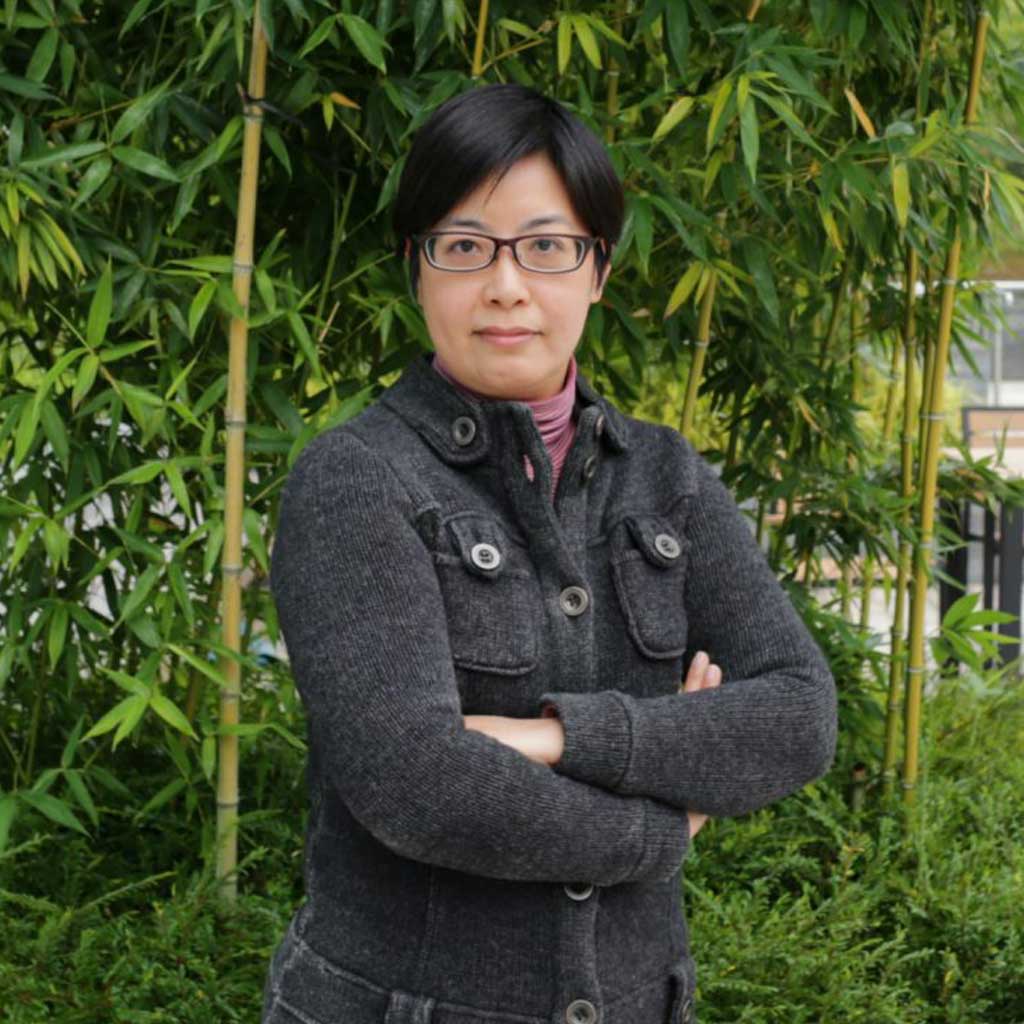
Dr HUNG Po-wah
(The Hang Seng University of Hong Kong)
Dr Hung received her PhD in East Asian Studies from the Australian National University. With a background training in Sociology, she is generally interested in issues on state-society relations in China and in particular the impacts on the everyday lived experience of the Chinese people. Her recent project looks at cross-border activities in the borderlands of China, paying particular attention to the development and inner workings of a shadow economy. Her research papers have appeared in the International Journal of Urban and Regional Research, Journal of Contemporary Asia, Journal of Gambling Studies, Social Indicators Research, Communist and Post-Communist Studies, and Modern China, among others.
Course: Making Public Policies Work Effectively: Bringing Multiple Stakeholders' Perspectives Back in
Making public policies work effectively involves serious efforts in bringing in multiple stakeholders' perspectives when conceiving, developing, and implementing policies to address complex social, economic, and political environments. The lecture and seminar series will critically examine how public policies are formulated in Hong Kong, an international city in Asia, under the guiding principle of "One Country, Two Systems". Case studies approach is adopted to engage participants in active and collaborative learning, reflecting public policy and public management issues against complex policy environments influenced not only by local factors but also by the broader political economy context
Enquiries
Please contact us at gs-event@hsu.edu.hk.
Co-hosted by
- Graduate School, The Hang Seng University of Hong Kong, Hong Kong SAR
- International Public Policy Association (IPPA)
- School of Transdisciplinary Studies, The Hang Seng University of Hong Kong, Hong Kong SAR
- Centre for Public Policy Research, The Hang Seng University of Hong Kong, Hong Kong SAR
Sponsored by
- Hung Fook Tong Group Holdings Limited