



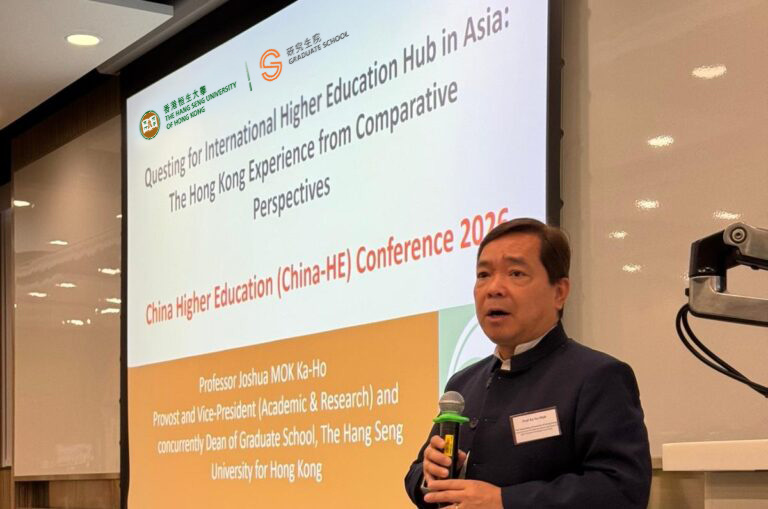
Prof. Mok’s Keynote Address
A research team from the School of Transdisciplinary Studies at The Hang Seng University of Hong Kong (HSUHK), led by Professor Ka-Ho Mok, participated in the 8th China Higher Education Conference, co-hosted by The Education University of Hong Kong and the University of Manchester. The conference brought together international scholars to examine the development of higher education systems in China and Asia within an increasingly complex global and geopolitical environment.
Professor Mok delivered a keynote speech entitled “Questing for International Higher Education Hub in Asia: The Hong Kong Experience from Comparative Perspectives”. The keynote forms part of his ongoing research project funded by the Public Policy Research Funding Scheme of the Government of the Hong Kong Special Administrative Region (Project No. E2025.B12.011). Drawing on comparative policy analysis, Professor Mok examined Hong Kong’s evolving role as an international higher education hub, situating its experience within broader regional and global contexts. In his keynote, Professor Mok highlighted the importance of diversity – across institutions, cultures, and academic traditions – in sustaining Hong Kong’s competitiveness as a leading education hub in Asia. He argued that diversity is a critical strength that enhances global connectivity, academic innovation, and resilience, particularly amid heightened geopolitical tensions and shifting international dynamics.
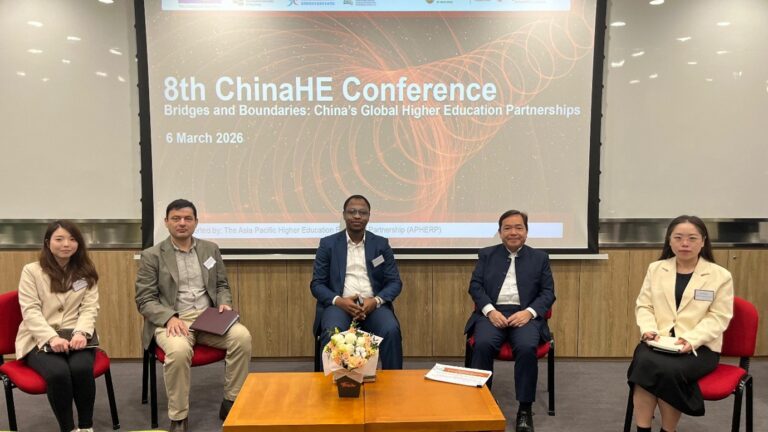
Panel Session at the 8 ChinaHE Conference
In the afternoon, Professor Mok and his project team hosted a panel session titled “The Quest for Education Hub in Asia: Comparative Perspectives and Policy Learning”. The session was moderated by Dr. Ayomide Oladosu (HSUHK) and it featured panelists Dr. Rainie Ke (HSUHK), Dr. Tian Zhen (The Hong Kong Polytechnic University), and Dr. Zia Ullah Akhunzada (The Chinese University of Hong Kong). The panel provided comparative insights into the development of emerging education hubs across Asia, with a particular focus on international student mobility. The panelists discussed how geopolitical tensions, policy changes, and global uncertainties are reshaping student mobility patterns, influencing students’ choices of study destinations and their overall educational experiences. A key highlight of the discussion was the team’s emphasis on social listening methodology as an innovative approach to understanding international student mobility. By analysing online discourse and student-generated narratives, the panel demonstrated how social listening can offer timely and nuanced insights into students’ perceptions, concerns, and decision-making processes, complementing traditional policy and survey-based research methods.
Through both the keynote and panel session, the HSUHK team contributed meaningfully to regional and international discussions on higher education policy, internationalisation, and education hub development. Their participation underscored HSUHK’s growing role in advancing comparative research and evidence-based policy dialogue on higher education in Asia.